
What CRM Tools Are the Best for Small Business Owners? A CRM for Small Businesses Guide
No single tool suits every owner, so choose the CRM for small businesses that fixes your biggest headache. Solo owners can use a free plan from HubSpot or Zoho. Small sales teams can look at Zoho, Pipedrive or Less Annoying CRM. Owners wanting an affordable CRM with invoicing and follow-ups can consider Saleoid.
A CRM, short for customer relationship management software, is a shared record of who your customers are, what you promised them and what happens next. Prices below were checked in October 2026 and change often. Saleoid publishes this article, so it appears here with its limits stated.
Which small business CRM software solves your problem?
· If leads slip through and money is tight: HubSpot free (up to 2 users) or Zoho free (up to 3 users) keep contacts and deals organized at no cost.
· If your team lives inside a sales pipeline: Pipedrive Essential centers on pipeline and deal tracking.
· If you dislike complicated pricing: Less Annoying CRM lists one plan at $15 per user per month on its own pricing page.
· If you want sales, invoices and email marketing in one place: Saleoid starts with a CRM foundation and adds apps as needed.
· If you expect to grow: Zoho has four paid editions, from Standard to Ultimate.
What does an affordable CRM cost for five people?
Picture a five-person design agency paying monthly rates on annual billing.
Zoho CRM Standard: 5 x $14 = $70 a month.
Pipedrive Essential: 5 x $14.90 = $74.50 a month.
Less Annoying CRM: 5 x $15 = $75 a month.
HubSpot Starter: 5 x $7 = $35 on its promotional price, or 5 x $20 = $100 at the other listed price.
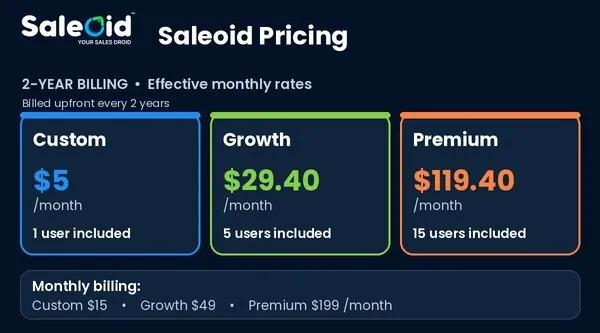
Saleoid’s foundation starts at $5 a month on a two-year plan, $9 on a yearly plan and $15 month to month, with extra apps from $1 each on two-year billing. Public listings do not say whether that covers one seat or several, so check seat terms on the pricing page before you plan around it. The tradeoff is the two-year commitment for the lowest rate.
Is an AI CRM for small businesses worth paying for?
It can be, if it removes routine admin. An AI CRM for small businesses suggests or handles repetitive steps, such as reminding you about a proposal nobody answered. For a consultant with no assistant, that matters.
Check what is included. HubSpot Starter comes with 500 HubSpot Credits for AI features, and Zoho’s assistant Zia is listed with its Professional edition. Saleoid describes itself as an AI CRM, announced publicly in July 2026, though its product roots date to 2013. Test its follow-up prompts on real leads during the 15-day trial before trusting the label.
An AI CRM for small businesses can be worth paying for if it saves time, improves follow-ups, and helps convert more leads into customers. Features such as automated reminders, lead management, customer tracking, and workflow assistance can reduce manual work and help small teams stay organized. However, businesses should compare pricing, available features, and ease of use before choosing a platform. An affordable solution like Saleoid can help small businesses manage customer relationships and sales activities without a large software budget. Start with your essential requirements, evaluate the available tools, and choose an AI CRM that delivers practical value as your business grows.
What should a CRM for startups offer?
A CRM for startups needs low cost today and room to grow. Look for cheap extra users, easy contact export and connections to the tools you already pay for. Saleoid’s GetApp listing shows Gmail, Outlook, QuickBooks, Stripe and Shopify, yet older reviews mention wanting more direct integrations.
A CRM for startups should offer essential tools to manage leads, organize customer information, track sales pipelines, and automate follow-ups. It should be easy to use, affordable, and flexible enough to support business growth. Features such as contact management, appointment scheduling, email integration, and sales reporting help small teams work more efficiently. Startups should also look for automation capabilities that reduce repetitive tasks and improve customer communication. An affordable AI CRM like Saleoid can help startups manage leads, streamline sales workflows, and keep customer interactions organized without unnecessary complexity or high software costs.
Conclusion
Choosing the right CRM for small businesses depends on your business needs, team size, budget, and preferred workflow. The best solution should help you organize customer information, manage leads, track sales opportunities, and follow up with prospects without adding unnecessary complexity. Before making a decision, shortlist two CRM tools and test them using real leads during a one-week trial. Compare their ease of use, essential features, and overall value. Most importantly, choose a CRM your team will use consistently. The right CRM can simplify daily sales activities, strengthen customer relationships, and support long-term business growth.